Sunny
High: 34°C
Low: 27°C

Stories about literature

Manto doesn’t let you forget

My first ‘experience’ of Manto’s work was with his short story ‘Khol Do’ – a deceptively simple tale set in the turmoil of pre-partition Pakistan that artfully depicts the horrors that ensued from and during mass migration.   I use the word ‘experience’, rather than encounter or stumble upon, because there is absolutely no way that you chance upon Manto’s work as one does a pebble in the path, kick it aside and calmly move on. Any human being that feels simply cannot be unmoved by Manto’s work. Akin to the brazen persona that Manto possessed, he consequently inspired either deep ...

Read Full Post

Faiz: Political poetry for the soul

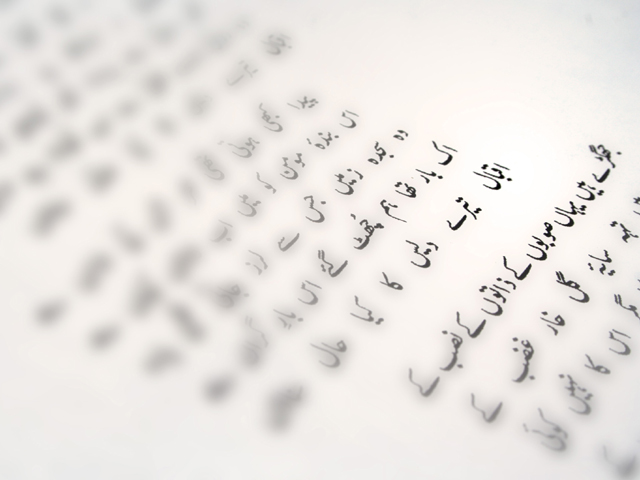
A piece of Faiz’s poetry looks like any other poetry. Black printed script on white parchment. The staid, two-dimensionality of parchment. The mundane blackness of the script. But as the reader’s gaze sweeps upon the verses, he is conscious of a clamor therein; a raging storm extricated within the dull entrapments of font and page, pining to be let loose, to disturb the tranquil air, to prod awake the sleeping conscience, to alter the course of the clouds, the blow of raucous winds, and flow of mighty rivers. Yes, these grandiose metaphors do complete justice to Faiz’s poetry, because the ...

Read Full Post

Sights and sounds at the Karachi Literature Festival

Foreign correspondents like conjuring the “books, not bombs” angle to justify the expense of flying down to Karachi to hear a bunch of people talk about politics and their books (in that order). But at this year’s Karachi Literature Festival there were bombs everywhere. Pervez Hoodbhoy led a discussion on bombs of the nuclear kind, Ayesha Siddiqa lobbed a few verbal bombs in Anatol Lieven’s direction for not nursing sufficient hatred for the Pakistan Army while Mohammed Hanif even dropped the deadliest bomb of all: the F-bomb. I began my annual pilgrimage to the Karachi Literature Festival by making a mental ...

Read Full Post

Jaipur Literature Festival: Prisoner of a palace

An outsider who has never been part of the Jaipur Literature Festival wonders what goes on for four days in the Diggi Palace, a 16th century palace owned by one of the descendants of some nondescript feudal lords. The day starts with four different sessions on varied issues running parallel in four different venues, aptly named Mughal Durbar, Mughal Tent and so on. Before lunch, three such sessions are held and writers interact with moderator and audience. The same continues after the elaborate rich Rajasthani lunch and it ends at 6.30 pm. Then, the music session starts and soon after, the bar and ...

Read Full Post

Manto: Still relevant, still cherished

January 18 marked the 57th death anniversary of Saadat Hassan Manto, the greatest and most controversial short story writer ever produced by Urdu literature. Manto jumped into the realm of Urdu fiction in the early 30s. In the wake of the Progressive Movement, when all writers inclined towards realism were ardently following the ideology of the movement, Manto was the only exception. He was a movement unto himself. With his unique treatment of the subject, and psycho-analysis of human behaviour, Manto turned the whole course of Urdu fiction, which until then was mainly under the influence of Prem Chand’s realism and ...

Read Full Post

Gabriel Garcia Marquez: Journalist, writer and carpenter

Most of us tend to believe, for good reason, that journalism is inimical to creative writing. Exceptions apart, the Urdu writers who have ventured into journalism have not returned to the world of literature. Gabriel Garcia Marquez, the South American writer, however, believes otherwise. He learnt, he says, from his own experience that literature and journalism are conjoined and nurture each other. An Urdu translation of the interview has been published in Kahani Ghar, a new literary magazine. Marquez, it seems, resents the use of tape recorders by interviewers, a standard practice these days. “I have a very good one”, he ...

Read Full Post

In praise of the Nobel Prize for Literature 2011

In case you didn’t notice, it was the annual literary maelstrom last week. The Nobel Prize in Literature was handed to somebody, Tomas Tranströmer of Sweden. The announcement evoked a global response which entailed synchronised hair pulling, angry tweeting, cynical literary opining in the millions. On the whole, it turned out to be an entirely predictable show of hostility from a world of outraged readers. The ruling sentiments went something like this: “Oh right! So Roth/Murakami/Pynchon/Nadas/Adonis is going to lose out AGAIN to somebody I’ve not even heard of?” “Wait, are you saying, like, this guy Transformer-whatever, haha, his work is ...

Read Full Post

The artist’s way

We live in an ugly world; there’s no doubt about that. For the past ten years we have been bombarded with images of terrorism, violence, destruction and death: on the television, in the newspapers and on the Internet. The most recent assault on our collective sensibilities and our battered sense of security is an image I just can’t get out of my head: Sarfaraz Shah begging for his life before being shot and left to bleed to death by the Rangers in Karachi this last week. As I said many months ago on Twitter, Pakistan is a nation in the ...

Read Full Post

VS Naipaul: Proud and prejudicial

“It is the best for all tame animals to be ruled by human beings. For this is how they are kept alive. In the same way, the relationship between the male and the female is by nature such that the male is higher, the female lower, that the male rules and the female is ruled.” This is what Aristotle said hundreds of years ago. It is a less than comforting thought that man has only evolved so much in the years following Aristotle. I say this after reading VS Naipaul’s latest attention seeking rant in Amy Fallon’s report in The Guardian. ...

Read Full Post

We who fight monsters

Remember that last scene in the movie Titanic when the ship is sinking but the band of musicians carries on playing the song “Nearer My God to Thee”? It’s routinely cited to illustrate the utter imbecility of men blinded from the obvious. I have thought of it the same way — except, now, when I try to write these lines. Now, I really wish I could do what those men did. Detach myself from the situation and go on to talk about poetry, and point out the niceties of form and imagery. I don’t know if you’ve ever noticed but ...

Read Full Post